
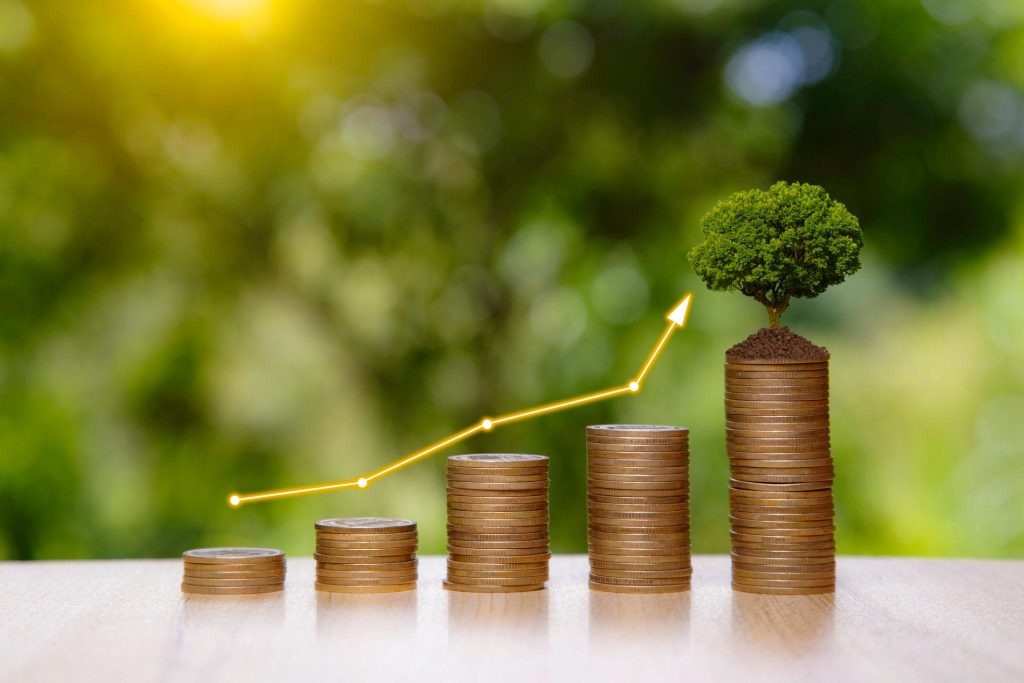
Albert Einstein is often quoted as calling compound interest “the eighth wonder of the world.” Whether or not he actually said it, the sentiment is right. Compounding is the single most powerful force in personal finance, and it is the reason a disciplined saver of modest means can retire with more wealth than a high earner who never got started. Understanding how compounding works – and, just as importantly, what breaks it – is the closest thing to a required course for any long-term investor.
At Great Point Wealth Advisors, we think about compounding on behalf of our clients every day. This post is our attempt to explain, in plain language, what compounding is, why it matters, and how to make it work for you rather than against you.
What Is Compound Interest?
Compound interest is interest earned not only on your original principal, but also on the interest already credited in prior periods. It differs from simple interest, which pays only on the original principal.
The formula, for reference, is:
A = P × (1 + r/n)^(n × t)
Where:
- A = the ending balance
- P = the initial principal (what you started with)
- r = the annual interest rate (as a decimal)
- n = the number of times interest compounds per year
- t = the number of years
The mechanics are simple. The consequences, over decades, are anything but.
A Quick Illustration
Suppose you invest $10,000 at a 7% annual return – a reasonable, inflation-adjusted long-run assumption for a diversified equity portfolio (S&P 500 real total return since 1926 has averaged roughly 7% annually).
| Years invested | Simple interest at 7% | Compounded annually at 7% | Extra earned by compounding |
| 10 | $17,000 | $19,672 | $2,672 |
| 20 | $24,000 | $38,697 | $14,697 |
| 30 | $31,000 | $76,123 | $45,123 |
| 40 | $38,000 | $149,745 | $111,745 |
Notice what happens as time extends. In year 10, compounding adds a few thousand dollars. By year 40, compounding is doing roughly three times as much work as the original principal itself. That is the “hockey stick” that long-term investors describe – the curve looks flat for a while, then bends upward sharply.
Why Time Is Compounding’s Best Friend
The single most important variable in any compounding calculation is not the interest rate. It is time. Consider two savers:
- Emma starts at age 25. She contributes $6,000 per year to a diversified portfolio earning 7% until age 35 – just ten years – and then stops contributing but leaves the money alone. Total she contributed: $60,000.
- Liam waits until age 35 to start. He contributes $6,000 per year at the same 7% return for 30 straight years, until age 65. Total he contributed: $180,000.
At age 65:
- Emma has roughly $631,000, having contributed $60,000.
- Liam has roughly $567,000, having contributed $180,000.
Emma invested one-third as much money and still ended up with more. She won by starting ten years earlier. That is the value of time. It is also the reason we tell every client with children or grandchildren: getting a young saver started, even in a small way, is one of the highest-return decisions you will ever make on their behalf.
The Rule of 72
A useful mental shortcut every investor should know is the Rule of 72. Divide 72 by your annual rate of return, and you get roughly the number of years it takes for your money to double.
- At 3% (a high-yield savings account today), money doubles in about 24 years.
- At 5% (a long-term bond return), money doubles in about 14 years.
- At 7% (a diversified stock portfolio, inflation-adjusted), money doubles in about 10 years.
- At 10% (the S&P 500’s nominal long-run return with dividends reinvested), money doubles in about 7 years.
Over a 40-year working career, a portfolio earning 10% doubles nearly six times. That is the difference between $10,000 and roughly $640,000 – without adding a single additional dollar. Rate of return matters, but the reason it matters is because it changes how many doublings you get.
What Compounding Actually Looks Like in the Stock Market
The S&P 500 has delivered an average annual total return of approximately 10.3% since 1926, with dividends reinvested – through the Great Depression, World War II, stagflation, the dot-com bust, the 2008 financial crisis, COVID, and everything in between. Adjusted for inflation, the real return is closer to 7%.
Consider what that century of compounding produced. According to Official Data, $100 invested in the S&P 500 at the start of 1926 with dividends reinvested would have grown to roughly $2.24 million by the end of 2026 – a 10.47% annualized return. Take dividends out of the equation entirely, and the same $100 would have grown to only about $1.7 million by 2017; with dividends reinvested it was worth roughly $59 million (Bogle, The Little Book of Common Sense Investing). Roughly 40% of the S&P 500’s total historical return has come from reinvested dividends, not price appreciation alone.
The lesson: reinvestment is not optional. Spending dividends and interest as they come in – instead of letting them compound – is one of the quietest ways investors sabotage their own outcomes.
The Real Cost of Waiting
New investors often ask, “Should I wait until I have more saved, or the market feels safer, or the rate is higher?” The math on waiting is unforgiving.
Assume a 25-year-old plans to invest $500 per month at a 7% average annual return until age 65. Here is what happens as their start date slips:
| Age at start | Monthly contribution | Total contributed | Portfolio value at 65 | Cost of the delay |
| 25 | $500 | $240,000 | ~$1,312,000 | – |
| 30 | $500 | $210,000 | ~$901,000 | ~$411,000 |
| 35 | $500 | $180,000 | ~$610,000 | ~$702,000 |
| 40 | $500 | $150,000 | ~$405,000 | ~$907,000 |
| 45 | $500 | $120,000 | ~$260,000 | ~$1,052,000 |
Waiting five years costs more than $400,000. Waiting twenty years costs more than a million. And notice – the additional dollars contributed by starting earlier are relatively small. The gains are almost entirely the compounded return on the time itself.
Compounding Is Not Just for Stocks
The same principles apply to any investment that generates a return you can reinvest:
- Bonds and cash. Interest reinvested at higher yields compounds just as stock returns do. As of mid-2026, the best high-yield savings accounts pay roughly 0% to 4.5% APY – far higher than the FDIC national average of 0.38%. The gap between a competitive rate and a lazy one, compounded over decades, is enormous. Where a client’s emergency fund or short-term reserves live matters.
- Employer 401(k) match. For clients still in the accumulation phase, an employer match is an instant 25%, 50%, or 100% return on the matched portion, and then that entire matched amount compounds tax-deferred for the rest of the working career. Not capturing the match is one of the largest single wealth-transfer decisions a working person can make against themselves.
- Real estate. Rental income reinvested into additional properties or into paying down principal creates its own compounding curve – one of the reasons real estate has been such a durable wealth-builder for many families.
- Business equity. Retained earnings reinvested in a well-run business compound at the return on invested capital of that business, which for high-quality operating businesses can meaningfully exceed public-market returns.
The vehicle changes; the math is the same. Time, rate, and reinvestment.
What Breaks Compounding
Compounding is quiet and slow, which makes it easy to interrupt. In our experience, these are the most common ways investors lose the compounding advantage:
- Selling in downturns. The April 2025 tariff-driven selloff sent the S&P 500 down 11% in two days. Investors who sold locked in the loss. Those who stayed invested saw the fastest recovery back to an all-time high from a 15%+ correction in the modern record. Missing even a handful of the market’s best days – many of which cluster during and immediately after downturns – can cut a decade’s return roughly in half.
- High fees. A 1% higher annual expense over 30 years reduces an ending portfolio by roughly 25%. Compounding works in both directions: high fees compound against you just as returns compound for you. This is why we build portfolios predominantly from institutional ETFs and share classes with the lowest possible expense ratios.
- Taxes on unnecessary trading. Short-term capital gains are taxed at ordinary income rates – often nearly double the long-term rate. Every unnecessary trade in a taxable account leaks compounding to the IRS. Tax-efficient investing, asset location, and specific-lot cost basis management are quiet ways to protect the after-tax compounding curve.
- Cashing out. The most damaging break to compounding is withdrawing money before it has had time to do its work. A 401(k) cashed out at a job change, an emergency dip into retirement accounts, or a mid-career “reset” can subtract decades from the wealth-building timeline.
- Not reinvesting distributions. Dividends and interest that are paid out and spent instead of reinvested cut a portfolio’s long-run return by roughly the dividend yield each year. Over decades, this dwarfs the initial principal.
- Trying to time the market. Every attempt to jump out at the top and back in at the bottom introduces two decisions where one wrong call is enough to destroy the compounding curve. The last three years have again demonstrated that the best days and the worst days sit closer together than the news cycle would suggest.
How to Set Yourself Up for Compounding to Work
The practical playbook is not complicated:
- Start now. The best day to start investing was the day you got your first paycheck. The second-best day is today. The math is symmetrical: every year of delay costs a compounded return you will never get back.
- Automate contributions. Regular, automatic investing – biweekly, monthly, or per paycheck – smooths out timing decisions, buys more shares when prices are lower, and removes the need to feel confident about markets in order to keep contributing. The academic name is dollar-cost averaging; the practical name is “not having to think about it.”
- Capture every employer match. At minimum, contribute enough to your 401(k) to get the full match. That is compounding on subsidized dollars.
- Reinvest dividends and interest. In accumulation, distributions should be set to reinvest automatically at the custodian.
- Keep costs low. Weighted-average expense ratios under 0.20% are readily achievable in most sleeves of a diversified portfolio.
- Be tax-aware. Use tax-advantaged accounts (401(k), IRA, Roth, HSA, 529) first. In taxable accounts, favor ETFs, hold positions long enough to earn long-term treatment, harvest losses, and manage cost basis intentionally.
- Stay invested through downturns. The plan should be written down so that your commitment to it does not depend on how any particular market feels on any particular day.
Frequently Asked QuestionsHow is compound interest different from simple interest?
Simple interest is calculated only on the original principal. Compound interest is calculated on the principal plus all previously accumulated interest. Over long periods, the difference is dramatic – often several multiples of the original investment.
How often does compounding matter – daily, monthly, or annually?
More frequent compounding produces a slightly higher effective return, but the difference between daily and annual compounding is small compared with the difference between a low return over a short period and a high return over a long one. Time and rate matter more than compounding frequency.
What is a realistic long-term return to assume for planning?
For a diversified stock portfolio, the U.S. equity market has produced roughly a 10% nominal / 7% inflation-adjusted annualized return since 1926. We generally plan on conservative assumptions below that historical average, because future returns are uncertain and clients are better served by pleasant surprises than disappointing ones.
Can compounding work against me?
Yes. High-interest debt – credit cards especially – compounds against you at rates far higher than any reasonable investment return. Paying down high-interest debt is often the single highest-return “investment” a household can make.
How do taxes affect compounding?
Every dollar paid in tax is a dollar that cannot compound. Tax-advantaged accounts, tax-efficient vehicles (ETFs, munis in the right accounts), tax-loss harvesting, and specific-lot cost basis all protect the compounding curve. This is why coordinated tax and investment planning matters.
Is it too late for me to benefit from compounding?
No. Compounding is not only for 25-year-olds. Someone starting at 55 still has 30 or 40 years of compounding ahead of them across their retirement horizon – often longer than they realize. The right answer is almost always to start with whatever you can, today, and build from there.
The Bottom Line
Compounding rewards three things: time, consistency, and discipline. Rate of return matters, but it matters most because it changes the pace of doublings – and every doubling is a gift from the years you have already invested. The stock market’s last three years – through the 2023 banking scare, sticky-inflation 2024, the April 2025 tariff shock, and the sharp 2025 recovery – have again shown that the investors who let compounding do its work end up meaningfully ahead of those who tried to outsmart it.
Our role at Great Point Wealth Advisors is to build portfolios and plans that let compounding do its job quietly in the background: broad diversification, low fees, tax efficiency, disciplined rebalancing, and a written plan that keeps our clients invested when the next headline arrives.
If you would like to see what disciplined compounding could do for your specific balance sheet, we invite you to submit an inquiry through our Contact page. For a broader view of how compounding fits into a full financial plan, please see our Retirement and Financial Planning page.
Great Point Wealth Advisors is an independent, fee-only Registered Investment Advisor. This post is for educational purposes only. Illustrations use hypothetical rates of return, are not guaranteed, and do not represent any specific investment. Past performance is not indicative of future results. Nothing on this page constitutes tax, legal, or investment advice for any specific person.